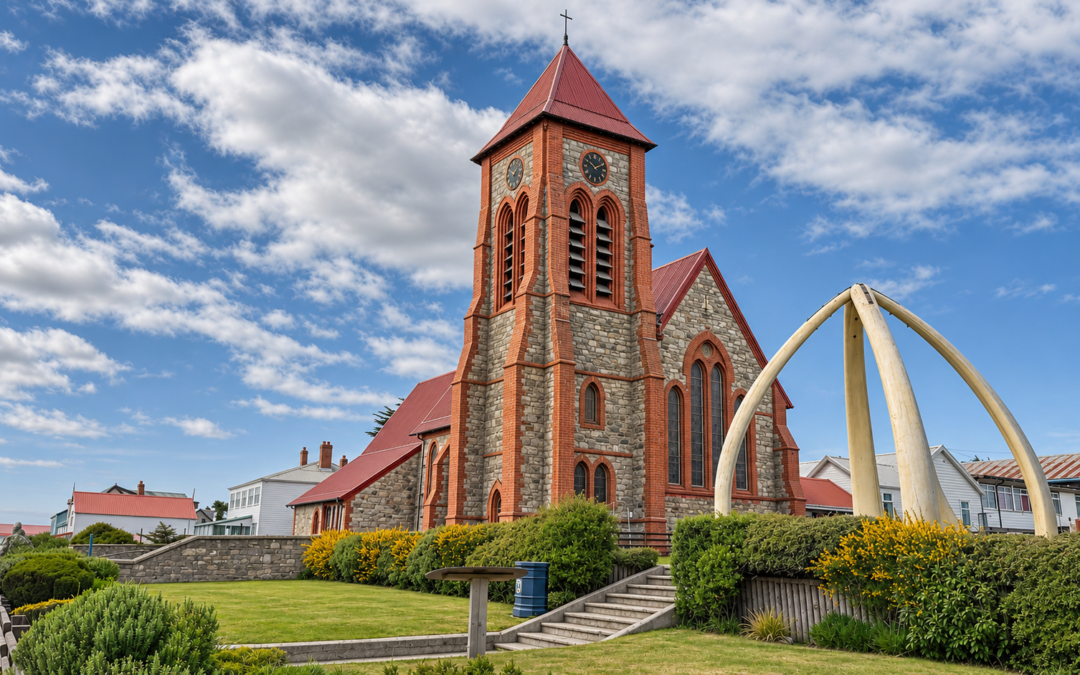
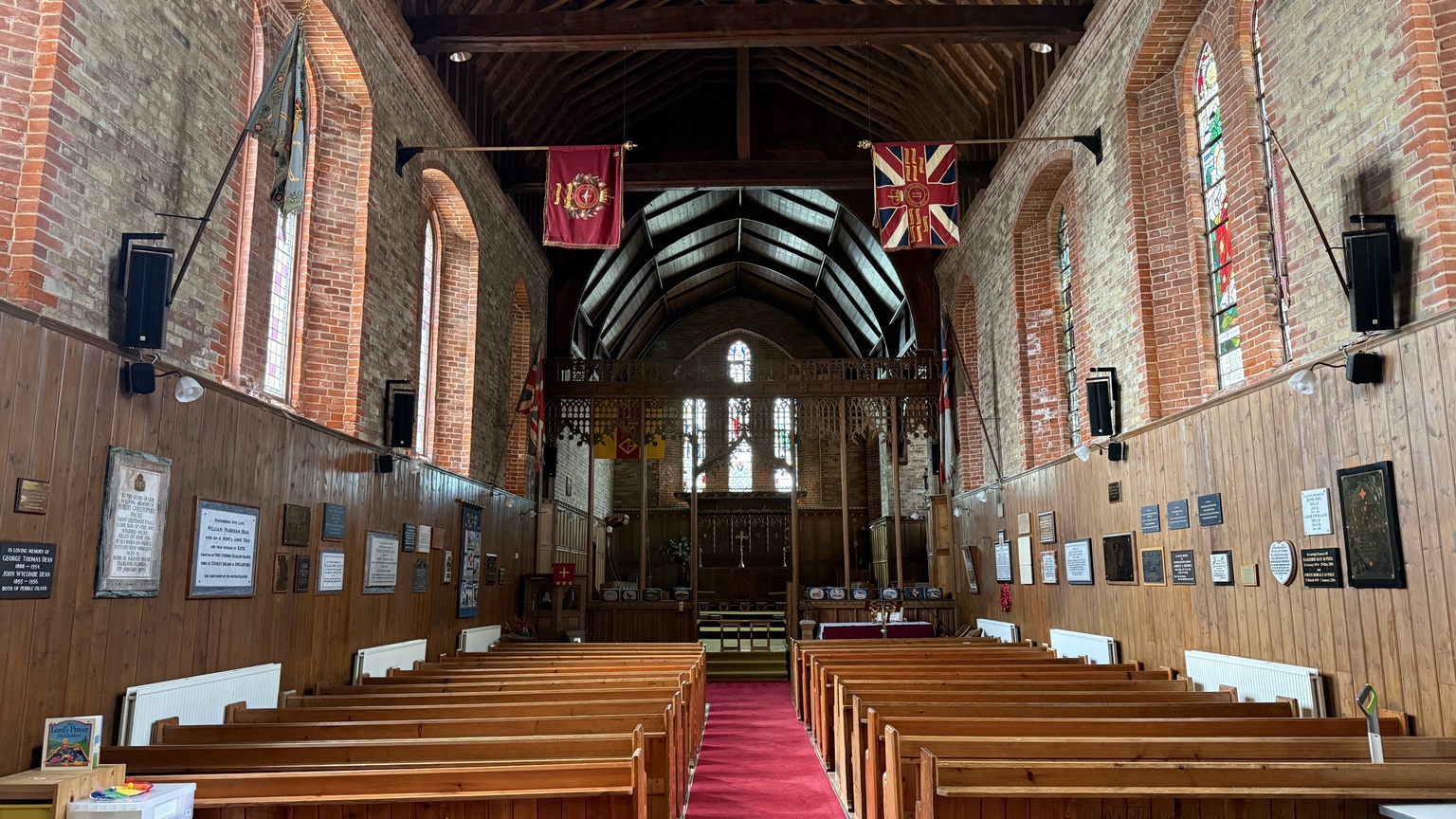
During my visit to Christ Church Cathedral in Stanley, in the Falkland Islands, a banner hanging against the brickwork caught my attention.
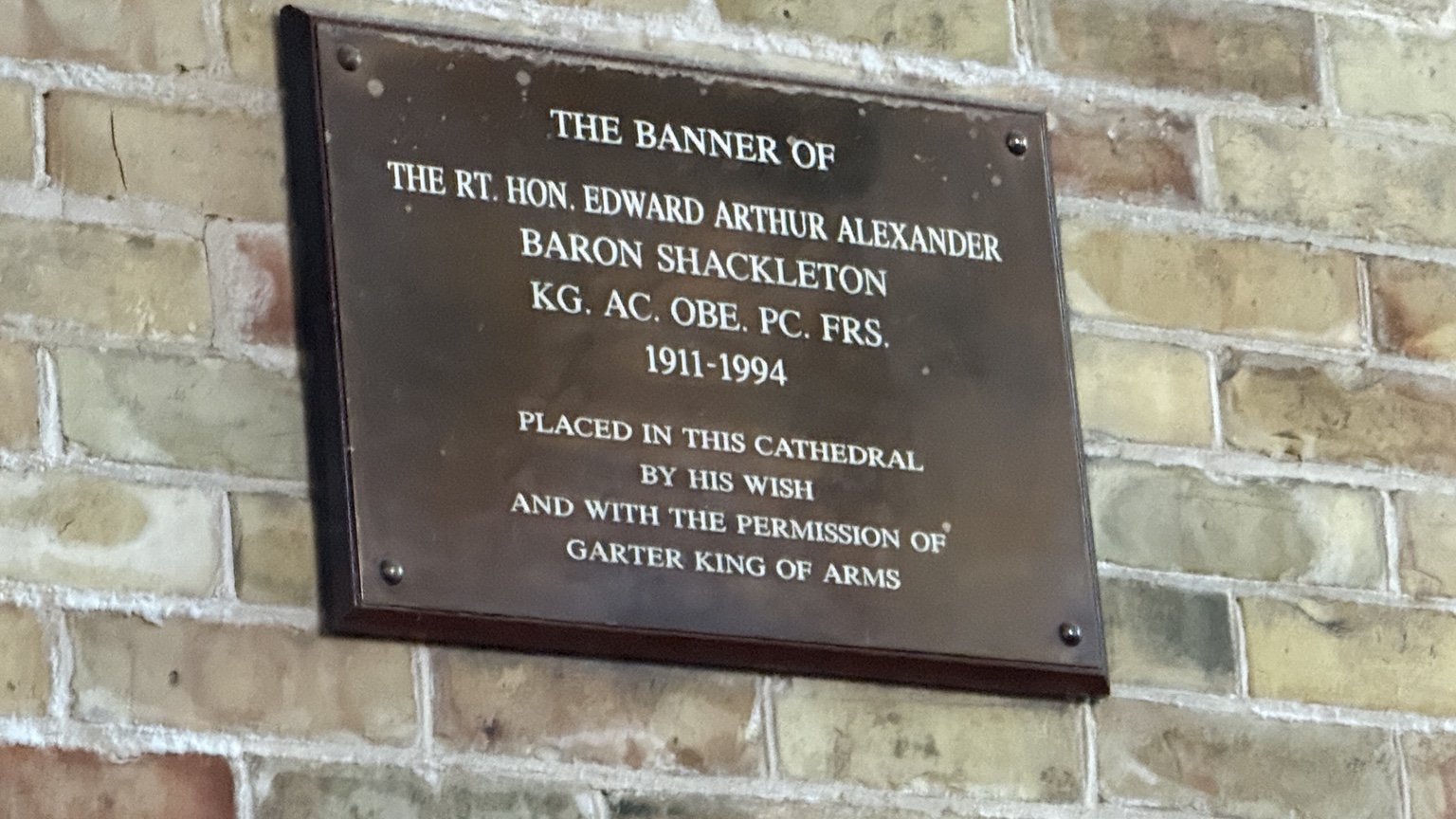
Beneath the timber roof, surrounded by memorials and reminders of the Islands’ history, its red and gold colours stood out. The plaque below identified its owner: Edward Arthur Alexander, Baron Shackleton, 1911–1994.
The surname was familiar. The story behind the banner was less so.
Edward was the youngest son of Sir Ernest Shackleton, whose expeditions remain such a powerful part of Antarctic history. Yet this memorial recognises a man who developed his own remarkable relationship with the South Atlantic.
The final words on the plaque explain why his banner hangs here:
“Placed in this cathedral by his wish and with the permission of Garter King of Arms.”
That personal choice gives it particular meaning.
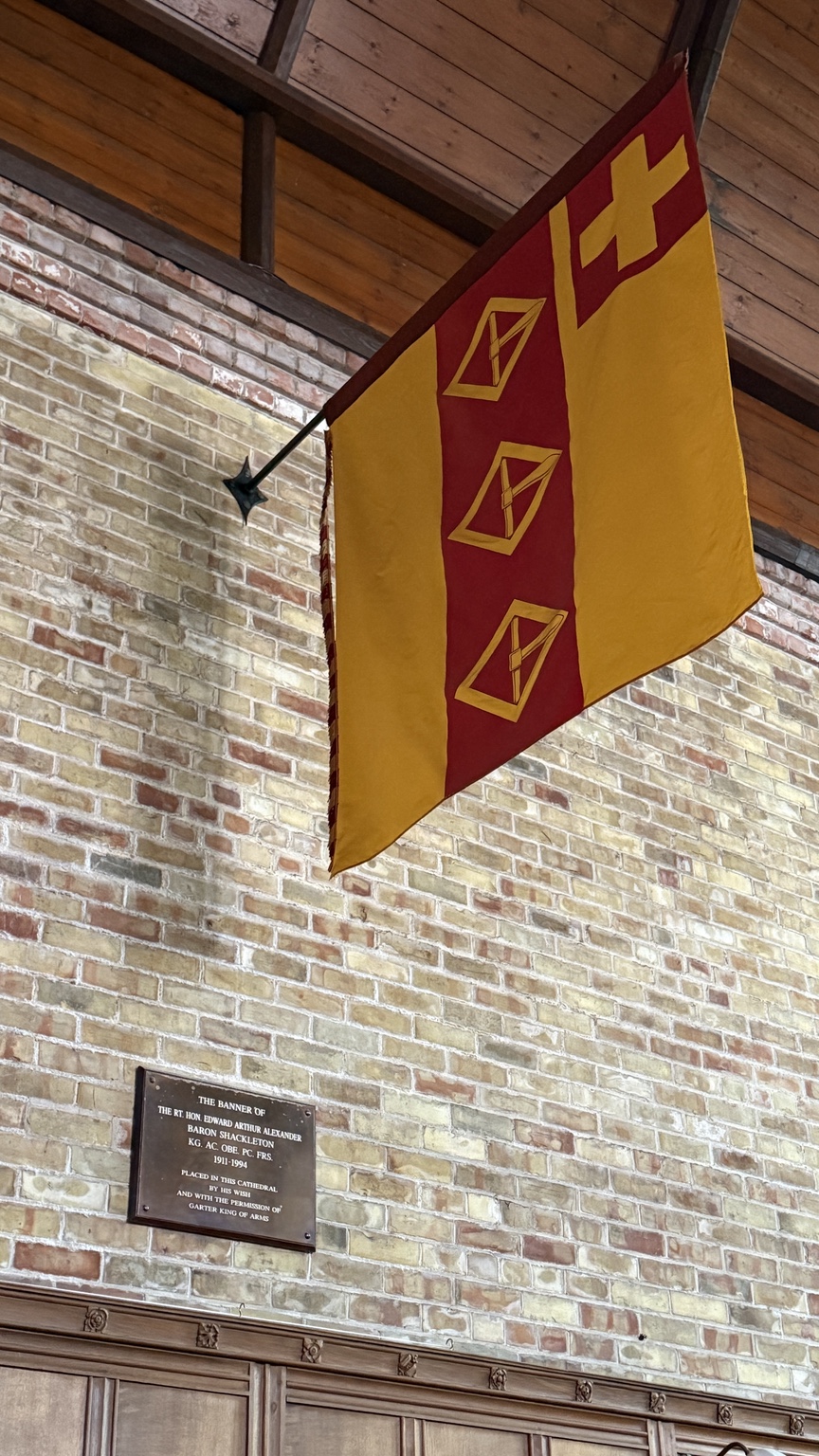
A banner from Windsor
Edward became a Knight of the Garter in 1974. Members of the Order have their heraldic banners displayed above their stalls in St George’s Chapel at Windsor Castle.
When a member dies, the banner is removed. It can then be placed elsewhere according to the wishes of the family or the person it commemorates.
Edward, who died in 1994, bequeathed his to the cathedral in Stanley.
It is a striking connection between two very different places: the royal chapel at Windsor and a cathedral overlooking the harbour in the Falkland Islands. To understand that choice, you have to look beyond his father’s reputation and into Edward’s own work.
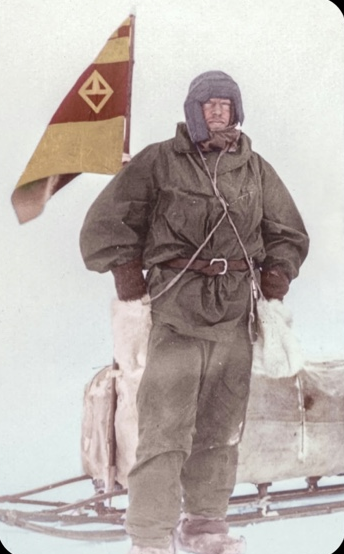
A flag linking father and son
After reading this article, polar historian Stephen Scott-Fawcett pointed out another connection: the design of Edward’s banner is identical to that of Sir Ernest Shackleton’s sledging flag.
That makes the red and gold banner more than a memorial to Edward’s public life. Its design also connects this quiet corner of Stanley with the flag his father carried on his Antarctic expeditions.
An explorer in his own right
Edward’s life included exploration long before his involvement in the Falklands.
As a young man, he travelled to Sarawak with the Oxford University Exploration Club. In 1934–35, he joined an expedition to Ellesmere Island in the Canadian Arctic, spending a winter there and undertaking a long sledging journey.
For me, that Arctic connection adds something important to his story. Here was someone who had experienced remote environments himself, before going on to a career in public service.
He later served in RAF intelligence during the Second World War, entered Parliament and became Leader of the House of Lords. He also served as President of the Royal Geographical Society.
His interests brought together exploration, science and government—fields that would all have a place in his work for the Falklands.
Charting a future for the Islands
In 1975, the British Government asked Edward to lead a study of the Falkland Islands’ economic prospects.
The survey team arrived in January 1976. Their task involved understanding the resources, challenges and possibilities of a small, remote community facing an uncertain future.
The resulting report looked far beyond a single industry. It examined air connections, fisheries, agriculture, land ownership, education and the organisation of government.
Those subjects might sound a long way from the expeditions usually associated with the Shackleton name. But they addressed questions that matter deeply in remote places: how people sustain a community, how they stay connected, and what gives the next generation a reason to build a life there.
Edward and his team identified opportunities for development at a time when confidence in the Islands’ future was far from assured.
Returning to the question in 1982
In May 1982, while the Falklands conflict was still underway, Prime Minister Margaret Thatcher asked Edward to update his original survey.
The circumstances had changed dramatically. Recovery and reconstruction would have to sit alongside longer-term development.
His updated report was published that September. It helped shape the discussion about the Islands’ economic future, including transport, infrastructure, farming and the potential of the surrounding seas.
The reports were the work of a team, and the development that followed depended on many people, particularly the Islanders themselves. Edward’s contribution was to help set out a practical direction and continue making the case for it.
A family connection with the South Atlantic
There is another poignant detail in Edward’s story.
During his 1976 journey, he visited South Georgia and saw his father’s grave for the first time.
Sir Ernest had died in 1922, when Edward was only ten. Decades later, his son arrived in the South Atlantic on a very different assignment, carrying the same surname but building a connection of his own.
Knowing that gives the banner in Stanley greater weight. It belongs within a family story that stretches across exploration, public service and a lasting commitment to this region.
What stays with me
Working in the expedition world, I often encounter the familiar names of polar history. Shackleton is among the most prominent, usually accompanied by stories of Endurance, survival and leadership.
A visit like this opens another chapter.
Edward’s banner is a reminder to look more closely at the names on memorials and the objects hanging above us. A few lines on a plaque can lead into a much larger story about a place and the people who helped shape it.
As we continue our journey towards Antarctica, I’m pleased to have spent a little time with this one. Our time in Stanley followed a change of itinerary, which I explore in Knowing When to Change the Plan: Leadership in the Drake Passage.
From Windsor to the South Atlantic. By choice.
Explore more Antarctic stories
The connections between polar history and today’s expeditions will also be part of my Ross Sea journey into Antarctic history. For more reflections from the field, visit my Expedition Journal.
Historical references: Dictionary of Falklands Biography: Edward Shackleton; College of St George: Garter banners; Hansard, 22 December 1982. Contemporary photographs: Antony Jinman. With thanks to polar historian Stephen Scott-Fawcett for reviewing the article, highlighting the sledging flag connection and sharing the historical photograph.